

Deep Sky Observations with Dwarf mini from August 2026
Conditions | Observation Overview | List of Observed Sky Objects | References
Since the beginning of January 2026, I own a DwarfLab Dwarf mini telescope for observing and taking photos of deep sky objects. On this page, I collect information about observations from August 2026 on. The photos that were taken during this phase are presented elsewhere (on the detail pages for the DSO).
Note: See also
- January to March 2026
- April to May 2026
- From August 2026 (this page)
Conditions
Sky Region and Objects
From August 2026 on, I observed mostly the following sky area (some better known objects are indicated):
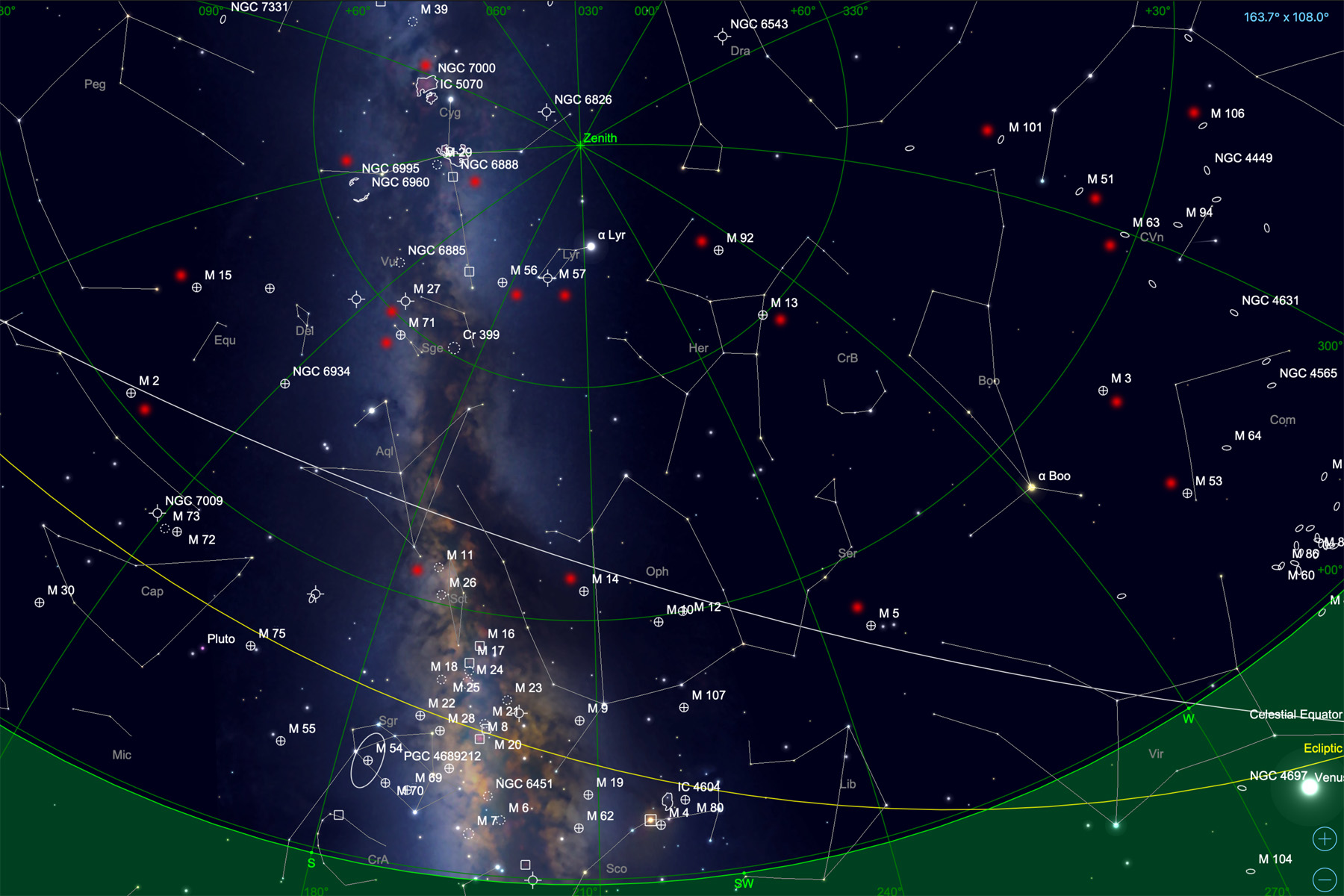
Click the map for a larger version - it opens in a new window (Image Courtesy of SkySafari Astronomy, www.simulationcurriculum.com)
Observation Time
The observations in this phase took place from August 2026 on. They typically took place shortly after dusk, when it was sufficiently dark for a successful initialization of the Dwarf mini. This was at about 11 p.m. in the beginnung of August, in September already shortly after 9:30 p.m., in October already shortly after 8:00 p.m..
Observation Location
The observations took place in Mühlhausen/Kraichgau (Germany):- Coordinates: 49° 15′ N , 8° 43′ E
- Coordinates (dec.): 49,25° N, 8,72° E
Equipment Used
When observing with the Dwarf mini, I only need the Dwarf mini and my iPhone or iPad. When needed (e.g. for EQ mode), I use the DarfLab Tripod that I bought together with the Dwarf mini. Filters are inbuilt (Astro, Dual Band, Dark) or delivered with the Dwarf mini (Solar Filter).
General Conditions
In general, the sky above Mühlhausen/Kraichgau is "light-polluted" (SQM 20.5) and does not invite you to search for deep sky objects. For astro photography, however, light pollution is not as disturbing as for visual observations.
Observation Overview
Observation Dates
Note: (15/60/Astro) means 15 s, Gain 60, Astro Filter - and analogeously...
| Date 2026 |
Observed Objects | Observed Objects, Details | Remarks | Further Remarks |
| Aug 10 MH |
G: M 51, M 101 | Order: M 51 (25 min), M 101 (30 min) |
Dwarf mini; iPad | M 51 observed with AZ from 11:02 p.m. (15/120/Astro); stopped at 23:34 p.m. after 101 subs (25 min) |
| Aug 11 MH |
G: M 13, M 56, M 92 Sun |
Order: |
Dwarf mini; iPad; sun filter | Sun (afternoon, 20 subs) |
| Aug 12 MH |
G: M 101 Sun |
Order: Sun (test; partial eclipse); M 101 (75 min) |
Dwarf mini; iPad; sun filter | Sun (afternoon, evening (eclipse), 30 to 40 stacks) M 101 observed with AZ from 11:11 p.m. (15/60/Astro); stopped at 0:45 a.m. after 301 subs (75 min) |
| Aug 13 MH |
G: M 51 | Order: M 51 (75 min) |
Dwarf mini; iPad | M 51 observed with AZ from 10:44 p.m. (15/60/Astro); stopped at 018 a.m. after 298 subs (75 min) |
| Sep 5 MH |
GC: M 71 OC: M 11 SP: Cr 399 PN: M 27 N: Sagitta |
Order: Nova V488 Sge (10 min), M 71 (22.5 min), M 11 (2 min), M 11 (13 min), Cr 399 (10 min), M 27 (25 min) |
Dwarf mini; iPad | V488 Sge (Nova Sagittae 2026) observed with AZ from 9:36 p.m. (15/60/Astro); stopped at 9:48 p.m. after 41 subs (10 min); SQM nearly 20 at start M 71 observed with AZ from 9:56 p.m. (15/60/Astro); stopped at 10:24 p.m. after 89 subs (22,5 min); SQM 20.05 at start M 11 observed with AZ from 10:34 p.m. (15/60/Astro); stopped at 10:36 p.m. after 9 subs (2 min); abgebrochen, weil ich 4 Sterne mit drauf haben wollte, die mir visuell als Hinweis dienten M 11 observed with star trazepium and with AZ from 10:40 p.m. (15/60/Astro); stopped at 10:56 p.m. after 51 subs (13 min); SQM 20.14 at start Cr 399 observed with AZ from 11:01 p.m. (15/60/Astro); stopped at 11:13 p.m. after 40 subs (10 min); SQM 20.24 at start M 27 observed with AZ from 11:17 p.m. (15/60/Astro); stopped at 11:46 p.m. after 100 subs (25 min); SQM 20.16 at start |
| Sep 9 MH |
GN: NGC 6888 | Order: NGC 6888 (15 min) |
Dwarf mini; iPad | NGC 6888 observed with AZ from 9:59 p.m. (15/60/Astro); cancelled at 10:17 p.m. because of clouds after 59 subs (15 min); SQM 20.1 at start |
| Sep 11 MH |
GN: NGC 6888 | Order: NGC 6888 (98 min) |
Dwarf mini; iPad | NGC 6888 observed with EQ from 9:41 p.m. (60/60/Duo); stopped at 11:30 p.m. after 98 subs (98 min); SQM 20.03 at 9:47 p.m. |
| Sep 14 MH |
GN: NGC 6992/5 | Order: NGC 6992/5 (118 min) |
Dwarf mini; iPad | NGC 6992/5 (Eastern Veil Nebula) observed with EQ from 9:27 p.m. (60/60/Duo); stopped at 11:37 p.m. after 118 subs (118 min); SQM 20 at 9:27 p.m. |
| Sep 18 MH |
GN: NGC 6960 | Order: NGC 6960 (118 min) |
Dwarf mini; iPad | NGC 6992/5 (Western Veil Nebula) observed as a 1:1.8 EQ mosaic from 9:22 p.m. (60/60/Duo); stopped at 11:38 p.m. after 118 (58/60) subs (118 min); SQM 19.8 at start and 19.94 at 11:55 p.m. |
| Sep 21 MH |
GN: NGC 7000 | Order: NGC 7000 (119 min) |
Dwarf mini; iPad | NGC 7000 (North Amerika Nebula, with IC 5070 Pelican Nebula) observed as a 1:1.8 EQ mosaic from 9:10 p.m. (60/60/Duo); stopped at 11:25 p.m. after 119 (59/60) subs (119 min); SQM 19.4 at start |
| Oct 5 MH |
GN: IC 1318 OC: NGC 6910 |
Order: IC 1318 (117 min) |
Dwarf mini; iPad | IC 1318 (Sadr Region with NGC 6919) observed as a 1:1,8 EQ mosaic from 9:55 p.m. (60/60/Duo); stopped at 11:10 p.m. after 117 (59/58) subs (117 min); SQM 19.2 at start, 19.94 at about 9:45 p.m., 20.2 close to the end; 5 days before new moon; EQ error 2°. |
| Oct 12 MH |
GN: NGC 6823 OC: NGC 6820 |
Order: NGC 6820/23 (118 min) |
Dwarf mini; iPad | NGC 6820/23 observed with EQ from 8:33 p.m. (60/60/Duo); stopped at 10:44 p.m. after 118 subs (118 min); SQM 19.9 at start; 20.3 at end; EQ error 1° |
| Oct 14 MH |
GN: NGC 7380, NGC 7635, Sh2-157 | Order: NGC 7380 121 min), Sh2-157 (120 min) |
Dwarf mini; iPad | NGC 7380 observed with EQ from 8:17 p.m. (60/60/Duo); stopped at 10:32 p.m. after 121 subs (121 min); SQM 19.7 at start; 19.8 at 9:30 p.m.; 20 at end; EQ error 1° |
| Oct 19 MH |
GN: NGC 7023, Sh2-155 | Order: NGC 7023 119 min), Sh2-157 (C9, 120 min) |
Dwarf mini; iPad | NGC 7023 (Iris Nebula) observed with EQ from 8:14 p.m. (60/60/Duo); stopped at 10:26 p.m. after 119 subs (119 min); SQM 18.7 at start; 19.2 at end; EQ error 2° |
Bold: First observation during this observation period; G = galaxy, OC = open star cluster, GC = globular star cluster, GN = galactic nebula, PN = planetary nebula, SP = star pattern, DN = dark nebula, C = comet, SN = supernova, SR = supernova remnant, N = nova; IT = integration time (net observation time)
List of Observed Sky Objects
Object details can be obtained via the links to the relevant deep sky objects.
|
DSO Details
|
Name | Constellation | Type | Remarks |
| Cr 399 | Coat Hanger | Vulpecula | SP | In binoculars better to see than in a telescope; the Dwarf mini shows it completely |
| IC 1318 | Butterfly Nebula, Gamma Cygni Nebula, with NGC 6910 | Cygnus | GN | Large nebulosity area around the star Sadr (Gamma Cygni) in constellation Cygnus; with open star cluster NGC 6910; observed with DuoBand Filter |
| IC 5070 | Pelican Nebula, with NGC 7000 | Cygnus | GNE | Large reddish nebula; together with NGC 7000 (partly) |
| M 11 | Wild Duck Cluster | Scutum | OC | Is located in the Scutum cloud, a special section of the Milky Way; therefore, the photos are full of stars. |
| M 13 | with NGC 6207 | Hercules | GC | Nice globular cluster, belongs to the largest ones; larger than M 5 and M 92; with spiral galaxy NGC 6207 |
| M 27 | Dumbbell Nebula | Vulpecula | PN | For me one of the most beautiful planetary nebulae |
| M 51 | with NGC 5195 | Canes Venatici | G | Nice spiral galaxy with connected satellite galaxy NGC 5195 and some more small galaxies |
| M 56 | Lyra | GC | One of the smaller globular star clusters | |
| M 71 | Sagitta | GC | Very loose globular star cluster | |
| M 92 | Hercules | GC | Nice globular star cluster with a compact core | |
| M 101 | Pinwheel Galaxy | Coma Berenices | G | Faint; with small galaxies nearby; better with longer integration time |
| NGC 6820 | with NGC 6823 | Vulpecula | OC | NGC 6820 is a small reflection nebula near the open star cluster NGC 6823. Both are embedded in the large faint emission nebula Sh 2-86. The whole area of nebulosity is often referred to as NGC 6820. |
| NGC 6823 | with NGC 6820 | Vulpecula | GN | |
| NGC 6888 | Crescent Nebula | Cygnus | GN | Nice, but faint; responds well to the DuoBand Filter |
| NGC 6910 | together with IC 1318 | Cygnus | OC | Small star cluster, together with IC 1318 |
| NGC 6960 | Western Veil Nebula | Cygnus | GN/SR | Faint; requires longer integration times and the DuoBand Filter; required also a mosaic this time; together with NGC 6992/5 a supernova remnant |
| NGC 6992/5 | Eastern Veil Nebula | Cygnus | GN/SR | Faint; requires longer integration times and the DuoBand Filter; together with NGC 6960 a supernova remnant |
| NGC 7000 | North America Nebula, with IC 5070 | Cygnus | GN | Normally only partly visible (together with part of IC 5070); better visible as a mosaic (DuoBand Filter) |
| NGC 7023 | Iris Nebula | Cepheus | GN | NGC 7023 is the name of an open star cluster containing the Iris Nebula. The Iris Nebula is a reflection nebula illuminated by a central star. |
| NGC 7380 | Wizard Nebula/Cluster | Cepheus | GN/OS | A star formation region that contains the young open star cluster NGC 7380 |
| NGC 7635 | Bubble Nebula, with Sh2-157 and more | Cassiopeia | GN | Like a bubble, with Lobster Claw Nebula Sh2-157, part of M 52, and more |
| Sh2-155 (C 9) | Cave Nebula | Cepheus | GE | Emission nebula; very faint, but result OK after 2h |
| Sh2-157 | Lobster Claw Nebula, with NGC 7635 and more | Cassiopeia | GE | Faint red emission nebula, with Bubble Nebula NGC 7635 |
| Sun | S | Two sun tests and partial eclipse of the sun on August 12, 2026 | ||
| V488 Sge | Nova Sagittae 2026 | Sagitta | N | Nova in Sagitta, discovered in August 2026 |
G = galaxy, GaC = galaxy cluster, OC = open star cluster, GC = globular star cluster, GE = galactic emission nebula, GR = galactic reflection nebula, DN = dark nebula, C = comet, PN = planetary nebula, SP = star pattern, A = Asterism, SR = Supernova remnant, HII = HII region (emission nebula in other galaxies), N = Nova
References
Books
- Michael Feiler & Philip Novak (2023). Deep Sky Reiseatlas (5th edition), Oculum Verlag (ISBN 978-3-949370-04-5)
www.oculum-verlag.de/detailview?no=608 - Ronald Stoyan (2021). Deep Sky Reiseführer (6th edition), Oculum Verlag (ISBN: 978-3-938649-72-9)
www.oculum-verlag.de/detailview?no=603 - Erich Karkoschka (2022). Atlas für Himmelsbeobachter, Kosmos Verlag (EAN: 9783440173602)
www.kosmos.de/de/atlas-fur-himmelsbeobachter_1074889_9783440173602
On this Website
- My Deep Sky Observations with the Dwarf mini (Complete List of Observed DSO)
- Dwarf mini - Information
|
made by  on a mac! on a mac! |


| 20.10.2026 |  |